Musings on the ongoing discussions of under-represented genders in SCA rapier
What I think of the still-ongoing-in-2026 discussions of under-represented genders in SCA rapier, and my personal thoughts on what it feels like to be supported (or not) in the SCA as a gender minority rapier fighter.
The data so far
h/t this post on Facebook https://www.facebook.com/groups/2401072975/?multi_permalinks=10163587073367976, reproduced with permission; data source for this chart is https://docs.google.com/spreadsheets/d/1iSsU6_-zQtF5zZpFBivu21xAxFFQ84HFFysp4lhsjAI/edit?gid=397669441#gid=397669441
“Here is the total number of Masters of Defense elevated, compared to the number of women and other under represented genders elevated as of February 2026 by Kingdom and percentage.” (note, I believe a few minor corrections are coming to this chart soon, based on the attention it has recently received uncovering some data fixes)
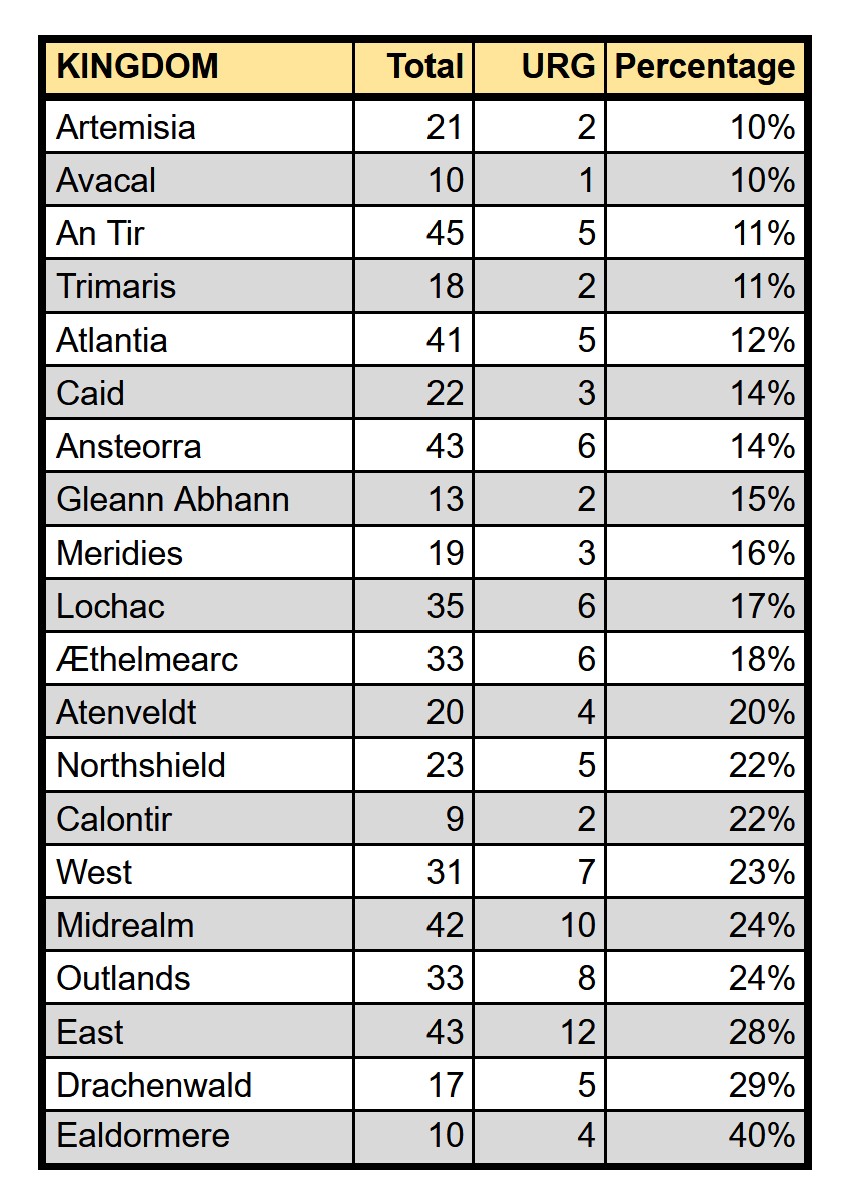
One major thing I take away from this chart is how few Masters of Defense there are in the SCA! Ealdormere, my current kingdom of residence, does well by this measure not only because we’re doing the right things (if/when we are), but because the n of 10 is tiny and each elevation skews our row in the chart by a lot!
You will, if you’re interested in the previous chart, also want to read this short paper from 2020, comparing male/female couples time to advance from AoA (likely their first award received) to DWS (grant-level) in six kingdoms: https://drive.google.com/file/d/1JRmu5Hnk35-2SjQsJ81fQmbIgZmnUd5s/view
And, official precedence-bearing recognition gifted by the Crown isn’t the only way to be recognized in the SCA; I previously gathered and analyzed data on participation in the East Kingdom Crown Tournament via Rapier with an eye towards gender diversity here, as winning Crown is one major way to receive high level recognition that doesn’t depend on a committee approving of you https://anne.loves.technology/anachronism/rapier/2025/05/07/armored-crown-east.html
Some of the data that’s missing
- How many rapier fighters are there total in the SCA, how long have they been playing, and when did they reach milestones; cross referenced by demographic data such as gender, age, and location
- Qualitative information about the experience of rapier fighters, and how this changes in aggregate based on gender
- How do changes in local kingdom MoD management systems impact who is recommended and who is elevated? (eg. the East has a mailing list discussion, the Outlands meets only in person for peerage circles, I learned on Facebook that Atlantia has a watch list of potential fighters to consider, apparently)
Systemic problems, systemic solutions?
I read an unrelated-to-this-topic blog post in my mundane life earlier this week: https://treyhunner.com/2026/02/on-the-enviromental-impact-of-llms-for-coding/. You can ask me my thoughts on LLM usage in some other time and place than the SCA, but, this at the conclusion of the post stuck with me:
Americans have a habit of thinking about systemic problems through the lens of individual action. As I noted in my lightning talk at PyCon last year, system-level problems require system-level solutions.
I believe that the problem of supporting rapier fighters who are not well served by our current system is a systemic problem. The SCA is mostly decentralized, and nobody “owns” solving this problem at a society-wide level, which limits what we know and whether we spend our time and energy effectively. Data collection is done piecemeal and by hand, and the society level stewards of our game clearly care about inclusion but don’t determine what happens to fighters at a local level. The SCA’s decentralization makes us stronger in many ways and allows us to operate autonomously at times when it can be quite beneficial, but it also has drawbacks, and unfortunate moments when it intersects poorly with the parts that do need to be centralized (I have been thinking lately about something that happened in Østgardr when I lived there in 2017-2021, but I don’t need to rehash it in public right now, ask me in private.)
Data collection by a centralized authority, although I cast it as a positive in the previous paragraph, is also a double edged sword (pun intended, you are currently reading a blog post about swordfighting). Accurate data can be a powerful tool to direct effective change, and, gender data collection must be trans inclusive in order to be accurate, and, here in 2026 in the current world we live in I am extremely skeptical that providing my trans status in a structured format to a centralized authority will not come back to bite me in the future. Are there privacy-preserving ways of doing data collection? Sure, and personal data should be treated with caution and respect, and the fact remains that I simply do not trust the SCA to be a respectful steward of all of my personal data right now. (I am still aware of https://creativeadministration.org/sca-lists-archive-breach/, yes, it has been several years, no, I do not think it will be meaningfully harder for a volunteer to make an equally impactful mistake today.)
So, what to do? I am not sure but in the absence of additional data, in this moment, I am anchored by my personal experiences. They are not inherently generalizable, and I believe that my experiences as a nonbinary person are substantially different in some places than the average woman-in-rapier experience (see more discussion of my viewpoint in the second half of this post: https://anne.loves.technology/anachronism/rapier/2023/08/08/pennsic.html) I want everyone to be supported, but, I only know what support feels like from my own perspective.
Miscellaneous thoughts on what it looks like for me when I feel supported
- Advanced fighters are attending my local practice, and spearheading/distributing the effort of teaching newcomers, so I as an intermediate-at-best fencer can focus on improving my own skill and not just on making sure that absolute newcomers have a good experience
- Advanced fighters are fighting me in particular when I am on the field at a practice, and helping me understand where and how to improve (I had an especially good week of this last week, I very much appreciated the attention I received)
- People pay attention to how I do in tournaments / when I do well in tournaments, people tell me they noticed me doing well / people offer advice on where to improve based on what they saw
- When I put in extra volunteer effort to improve our game (e.g. marshalling), that effort is noticed and I am thanked
- When I ask for help, I receive it (e.g. when I was baronial marshal and was traveling during a weekly practice, someone else was usually able to host practice that week)
- When I am struggling, I am given a graceful path to recovery (e.g. when I am upset about something in particular, an informal conversation with a friend or a mentor to help me understand what I can do about the upsetting thing / why it happened)
- My informal SCA community (my household, being a provost to my Maestra, etc) advocates for me in the contexts where they do have formal access (circles, officer positions, etc)
Most of these support actions are not gendered in any way; almost anyone can support anyone else with them (though more-experienced people can do more to enact some forms of support)
Quick conclusion
Do I think more can be done to support underrepresented genders in martial arts and in SCA rapier in particular? Yes, and I would like to continue discussing exactly what to do and how to do it. Should the SCA be more central in this or less? Where are we doing well and where are we doing poorly? I would love to see more constructive engagement with the topic, and less shouting on Facebook about who is responsible for this burden - since, after all, many hands make light work.